
The
Birth of the American 12-string Guitar
by
Gregg Miner
Rewritten July, 2013
Last Update:
August 2025
INTRODUCTION
For
those wishing to skip to the heart of the matter, just jump to the end
of this article. However,
as it took me quite a while to get there, you may find the provenance,
and my eventual analysis worth reading first.
What started out as just an interesting little blog - from
something I unearthed in my harp guitar �To Do� folders - ended up as an
extensive and pretty exhaustive research project, so I
published it here on the more permanent site � even though it has less
to do with actual harp guitars than standard guitars.
As
this site is of course harp guitar-specific, I should note that I am going
decidedly �off topic� and referring to what nearly everyone today
considers the standard �12-String
Guitar.� In other words,
the regular steel string guitar with 6 double courses (the 4 lowest
strung in octaves, the top 2 in unison) � not a 12 string harp guitar
such as a Dyer with 6 on the neck and 6 subs.
So
what does the 12-string guitar, popularized by dozens of memorable
players from Leadbelly to Leo Kottke, have to do with harp
guitars�in
fact, two completely different families
of �harp guitars�?
I
propose that the ubiquitous 12-string guitar may have largely evolved
from and been inspired by
two previously overlooked instruments: An early
non-floating-strings instrument named the �harp-guitar,� and the true harp guitar with floating
strings.
All
the previous theories I could locate were that the 12-string was inspired by double-course guitars
from south of the border, like the baja
sexto, or developed in the workshop of some American factory like
Oscar Schmidt. Michael
Simmons has written a couple articles over the years on the 12-string
which are worth noting. Probably the latest in 12-string circles is the increasing
awareness by esoteric collectors and players of the little-known early (very
early) Holzapfel 12-strings.
Then
there are ongoing studies of obscure New York Italian
makers.

There
has
been some mention (Simmons,
again), though little follow-up discussion, of my main candidate �
specifically, an instrument by Rene Grunewald, which is the key to our
puzzle. Michael shows a
c.1904 ad for this 12-string instrument.
But we have to go back a little further.
Feb 8, 1896, to be precise.
That�s
when one Carl E. Brown, of Columbus, Ohio, filed his patent application
for his own �harp-guitar� (you�ll remember from my Organology
thesis that anyone is free to call their invention a �harp guitar�
� it needn�t be a version of the harp guitar with floating strings,
as classified today).
Brown�s
curious patent (#568,108) has been on this site from the beginning, on
the Patents page and in the �Harp
Guitars in Name Only� Gallery.
It consists of not 12, but 10
strings, which I believe is an important observation and distinction for
our purposes of �12-string guitar evolution� and provenance.
In other words, my stance is that this particular 12-string
variant would not have existed without there being a 10-string first,
and this
instrument was invented for a very specific use and effect � and very
much �of its time.�
[�Harp
Guitars in Name Only� Gallery](../org/org-name_only.htm)
The
Grunewald instruments (at least the 10-string version) list Brown�s
patent number on the label, and thus these labels would seem to point to
a possible obscure beginning to the 12-string guitar story.
So I�m surprised more attention hasn�t been paid to this.
But the real evidence comes from reading the weekly Music Trade
Review of the period and understanding the context of the prose, and
also that of the related BMG world (�Banjo, Mandolin and Guitar�
community), as focused through The Cadenza, and later, Crescendo,
magazines.
PART
ONE
Before
I delve into these magazine appearances, let me present our Part 1 Cast
of Characters:

Brown:
Carl Brown, a
(definitely wacky) inventor, from Columbus, Ohio.
Some of his work seems to have had to do with the piano, but
besides his groundbreaking 10-string guitar (perhaps its only flaw being
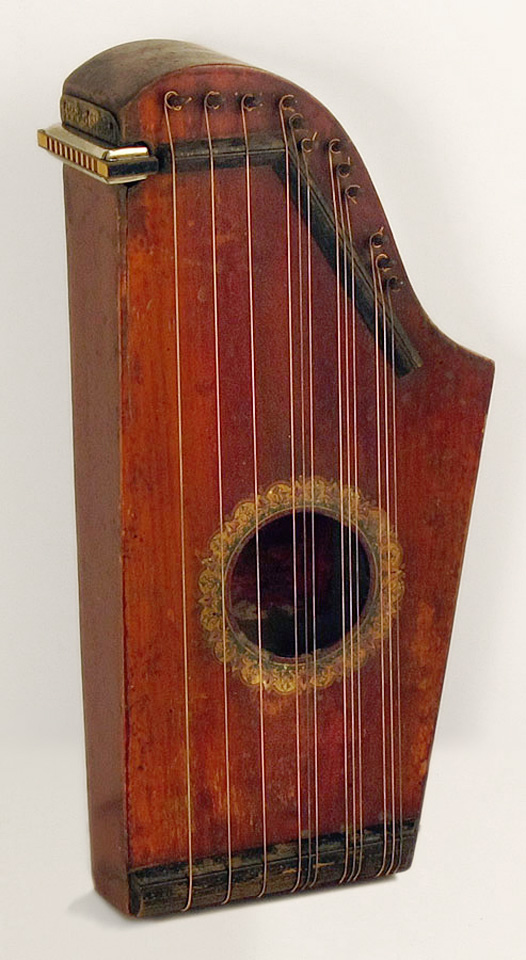
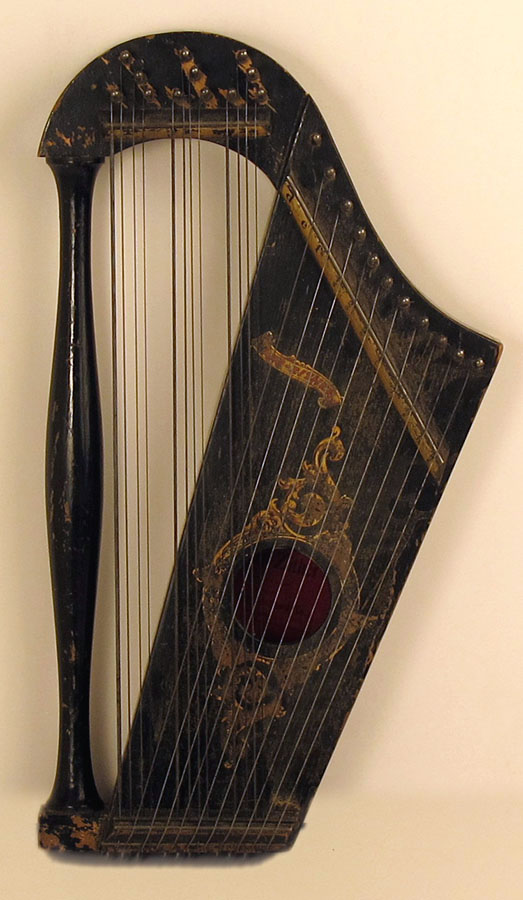
its novelty �olden days� shape), he also invented the laughable �Harp-o-chord,�
that unusual harmonica and zither combo.
The appearance of the be-suited professional demonstrating the
instrument in the advertisements assures us that Brown was serious.
He also patented 3 other fairly useless zither designs, the �Harp-Zither�
- a simple, though attractively-shaped, fretless zither � and 2 other
�zither body shapes� which were actually produced and sold, though
they had only 3 or 4 strings each! (You
occasionally see them on eBay, where they are easily mistaken for toys).

Gordon:
Hamilton Gordon of New York, a successful musical
instrument entrepreneur by 1895.

Grunewald:
A large musical enterprise in New Orleans headed by
patriarch Louis and 3 sons, of which Rene
(pictured) is of interest to us, as head of their manufacturing division
(by 1895). Rene was born in
1869 and died in December, 1914. By
1897, he ran their very successful mandolin factory, which was soon
adding guitars to the line. By
1904, they became a huge maker and distributor of banjo and drum heads.
This led to their infamous advertising campaign (as featured in the Spring, 2009 Fretboard
Journal) with the tag line �WE WANT YOUR SKIN� (or
�Give us your skin� - referring to the
fact that they were actively buying up animal hide for the mass
production of skin heads for musical instruments).
A legitimate business undertaking, but certainly an off-putting,
if not downright macabre, slogan - even without today�s post-Silence
of the Lambs perspective.

The Rudolph Wurlitzer Company:
Specifically, the son Howard Eugene
Wurlitzer who ran the business from about 1900. Wurlitzer had a brand
name named for him from 1896 into the 1920s.
And
now, with access not only to a nearly full run of Cadenza
magazines, but
also the
recent Music Trade Review
(TMTR) online
archives and
still-growing Chronicling
America online archives
(please
have it, I�m sure I haven�t found every relevant entry),
we can see a better timeline of the Brown invention and
its
subsequent
manufacture.
[Music Trade Review
(TMTR) online
archives](http://mtr.arcade-museum.com/)
[Chronicling
America](http://chroniclingamerica.loc.gov/)
Equally
important, we can see the reasoning
behind the instrument, and visualize its intended audience.
April 11,
1896:
TMTR: �The Harp-Guitar�
This
is the first news of Brown�s 10-string invention, which has been on display in
a local store �for the past week.�
The necessity to describe in detail the new stringing and tuning makes
clear that it is considered a �novel� concept for a guitar.
Mention is made of the tone, which �resembles two instruments�the
mandolin and guitar� (not a harp and guitar, as Brown�s patent pronounces).
Though cryptically stated, the writer alludes to a �simple
arrangement� (a device to be explained in a later issue) via which the effect
of either a guitar or mandolin �can be produced.�
They mention the patent application, which had occurred 2 months prior
(Feb 8). The primary purpose of the
patent invention is clearly stated at the outset: ��to
combine the features of a harp and a guitar.�

August 22, 1896: TMTR:
�A New Musical Novelty�
This article announces that Brown�s patent
(at left) has now been granted. The
pear-shaped body is described as having �the general form of guitars of �ye
olden time�� (whatever that�s
supposed to mean) � which was probably intended to add to its �novel�
aspect. It then repeats the details
of the stringing and tuning.
Next is the claim that this arrangement makes it
�much more simple than on the guitar, (due to) the air being picked with the
thumb on the double strings, while the accompaniment is played with the fingers,
and thumb when unoccupied, upon all the available strings.�
This verbiage is taken from Brown�s own patent, though
the phrase must be looked at in context � for the amateur guitar style was
then much as described; the thumb played a simple melody, with fingers playing a
(generally higher) simple accompaniment. In
other words, the point is not that
Brown�s new instrument was the first to introduce
this style, but
that
it was created to better take advantage
of the basic style.
As this somewhat confusing point occurs throughout several years of
advertising (Grunewald still using it in 1904), and to confirm that this was
indeed the playing practice of amateur guitarists at the time (I am no expert),
I went to the source: Jeffrey Noonan, author of The
Guitar in America. No one has
studied the early literature and music more than Noonan.
He summed it up for me thusly: �The �bass solo� style was very
common for amateur players - even as late as the 1920s The
Cadenza (or maybe Crescendo)
published some solo arrangements by Sophocles Papas (as close to Segovia as you
could get) - and every one of his arrangements was in the �bass solo�
style. Lots of the late 19th-century
solos in the magazines were in this style and were clearly aimed at the amateur
player.�
Though Brown did not pass up the opportunity to
tout the �increased� tone and volume of
�nearly double that of the guitar� (after all, every
new builder and inventor did this routinely), the crux of his invention was the
added octave strings on the 4 low courses. But
again, this was not to create a novel means of introducing a strange new playing
style � the thumb melody � but to
expand the musical range of what
was already
a common amateur playing
style (the �bass solo� style).
This is made clearer in the next sentence,
when the writer explains that �the fingering is much more simple than
upon the guitar, for by means of the four
extra treble strings, one is enabled to render almost any ordinary piece of
music with the left hand in the first position, there
being two and one-half octaves under the hand in this position�
(italics mine). Get it?
They�re describing the characteristic well known to 12-string players
� that either the low or high octave of the 4 lowest courses can be accented
(naturally occurring depending on whether a down-stroke or up-stroke is used on
the pair of octave strings); or they can even be separately plucked.
Brown�s idea then is to just leave the left hand in first position,
period, and let the high octave string in those 4 low courses extend the melody
upwards. This is assuming the
amateur player can get the hang of this tricky transposition!
Brown seems quite confident, as the article claims �On the guitar there
are eighteen frets, while only four or five are needed upon the harp-guitar.�
There you have it! It goes on
for a couple more paragraphs about how much easier it will be to play all the
popular airs and such.
The tone is given additional press (�autoharp or
mandolin� plus guitar), with �volume�being nearly double that of the
guitar.� Strange that there is
still no allusion to a �harp� tone, as that is the name of the new
instrument, and the only term used by Brown in his patent.
With nary a mention of mandolin or autoharp effects in Brown�s patent,
I would propose that the TMTR writer perhaps saw and heard an actual instrument,
and drew their own conclusion (and a more accurate one).
Next, the �double instrument� feature is explained a bit more,
describing how by �throwing a small lever it can instantly be converted into
an ordinary guitar, this being accomplished by silencing the extra treble
strings.� The patent clearly shows
and explains this device: 4 hooks on a bar mounted across the soundhole are
positioned over the high strings (the ones that make it sound
�mandolin-like� or as Brown states, �harp effect�).
The lever linkage pulls them down out of the way, leaving just the
standard 6 strings accessible�in theory.

Finally, we learn that �two prominent
manufacturers will place the instrument on the market this coming fall.�
Before continuing, note that we�re still talking
about Brown�s 10-string.
There are two simple reasons why
Brown didn�t include twelve. Just
like today�s 12-strings, the physics of string technology don�t allow a
24-25�-scale steel string that can be tuned to a high b� � so the octave configuration
must necessarily
stop at the 3rd G string.
Modern 12-strings of course double the E & B for balance and to
better approximate the �jangle� of the octave courses.
Brown was only interested in extending
the range
of
pitch
in first position � so he saw no point in just adding another
unison string.

June
26, 1897: TMTR: �The
Gordon Harp-Guitar�
[�The
Gordon Harp-Guitar�](Gordon,1897,Jun26-mtr.pdf)
At the �Gordon musical merchandise warerooms�
(in New York), the first of Brown�s �two prominent manufacturers� places
the instrument on the market. I
don�t know who built Gordon�s instruments; it probably could have been any
number of East Coast shops or factories. Whoever
it was copied Brown�s patent drawing (and likely the prototype(s) pretty
closely, except for the headstock, which is instead a more interesting and
attractive asymmetrical shape. We
may never know whose design this actually was.
The woodcut shows a very similar pear-shaped, ��ye
olden time� body and the distinctive bridge shape.
However, the whole reason for the bridge shape is the extension for the
lever for lowering the high strings. This
is not included, nor the device itself in the soundhole (as in the patent
drawing, above) - though its effect is mentioned in the text.
This is the first time that the tone of a �harp� is brought up;
specifically, with all ten strings engaged, it is a �harp�; with the 4
extras silenced, it is �converted to guitar� � exactly that of Brown�s
original premise.
UPDATE, 2025: As shown above, the "Gordon" omitted the lever mechanism. Below, we will also see that none of the
Grunewald (or other) 10-string "harp guitars" ever incorporated Brown's original
patented lever mechanism? Why not?!
Finally, in August 2022 (sold on eBay), the
very first "Brown mechanism" turned up...in still another
new member of our Cast of Characters: The Wurlitzer Company! Were
they one of Gordon's intended manufacturers? The entire design is
identical to Gordon's. Yet it has Wurlitzer's own label. How to read
that label is still something that vexes me. It seems to read
"Eugene Howard Maker" with "Howard" as the surname or "brand." But the
person must actually be Howard Eugene Wurlitzer (1871-1928), the first son of
founder Rudolph, who ran the company from about 1900 when his father's health
declined. Thus, perhaps the label is meant to represent the brand
("Howard," the company head's first name), with his middle name, then
"maker"? It's certainly an odd choice. The company name Wurlitzer
does not appear anywhere, though was represented in the missing from logo, which
would have looked like the one at far right below, shown on the back of a
6-string. The backwards "R" and
conjoined "W" and "B" formed the Trademark - "Rudolph Wurlitzer and Brother" -
for the original company (his brother Anton being a partner from 1862-1890).
The third photo clearly shows
the Brown patent mechanism. The player moves the lever down into a locking
slot which pulls the section with the four individual fingers down out of the
way.
Dating this instrument may be impossible.
Young Howard had already begun working with his father in 1890, and
Michael Holmes� Mugwumps
Encyclopedia listed "Howard" as a �Wurlitzer brand name (1896-1920s).�
Therefore,
it could have been built as early as 1896 or 1897 (under a Brown license) or
after 1910 when the patent expired.
[Mugwumps
Encyclopedia](http://www.mugwumps.com/AmerInstMkr.html)


October 2, 1897: TMTR:
�Harp-Guitar � A New Invention�
�Harp-Guitar � A New Invention�
And now, the most prominent manufacturer, Rene Grunewald, unveils
his harp-guitar (under the same patent).
It is not yet pictured.
While
many TMTR �articles� reek of favoritism (quid
pro quo if not payola), evident in the obvious advertising hyperbole, the
level is amped up here, perhaps by Grunewald, himself?
Essentially
describing the same playing advantages as the previous notices, the copy is well
worth reading, as you guitar players will discover that you may very well have
wasted �years of tedious practicing� learning how to run �up and down the
fingerboard� for nothing!
Before we ridicule Grunewald too strongly, it
should be noted that the claim of being �famous in musical circles all over
the country� was not without some merit.
The
Louisiana Grunewald firm was then large and well established, and Rene�s
mandolin factory had been mentioned several times by this point, with notices of
success exporting vast quantities of (bowl-back) mandolins, and later guitars,
to other countries.
Still, the true newsworthiness of The Music Trade
Review must fall under some suspicion.
Certainly
they were much more impartial than the Cadenza, and later Crescendo, magazines,
which rarely included a single glad-handing sentence about any manufacturer or
brand name who was not one of that issue�s advertisers � yet TMTR�s
�stories� and notices � intended for the trade rather than the final
customers - seem intended to hype the topic, first and foremost.

January 22, 1898: TMTR: �The Grunewald Harp-Guitar�
Grunewald�s instrument is now shown, and we see
that his company wisely chose to use a normal guitar-shaped body.
All other particulars seem to match the Gordon/Wurlitzer � the asymmetrical
10-string headstock and the distinctive bridge, though once again, the required
(and even alluded-to) lever and hook assembly are mysteriously absent.
The write-up is similar to the last one, and even
longer. Grunewald and/or the writer
revert back to tone comparison to a �concert autoharp� or �mandolin and
guitar.� They are now even more
strongly advertising this as something for a beginner or amateur, an instrument
that can be �mastered�with a few days practice� unlike the standard
guitar. Though still �novel,�
someone at TMTR seems to be pushing this as a practical, useful instrument.

At left
is one of the rare surviving specimens (sold by Retrofret).
Everything seems to match the woodcut exactly, including the
specially-shaped bridge designed to incorporate the lever for lowering the extra
strings. But just like the woodcut,
this is missing, and in fact, looks like it was never there to begin with.
Perhaps they thought
it just
�looked cool�?


A second specimen appear to be idential to the Retrofret
example; it has the "correct" bridge, but again, no lever.
(At right) Later
on, while still a 10-string model (at right), Grunewald appears to have switched to a
standard bridge, with the same 2 strings under one bridge pin, and separated on
the saddle by a tiny pin. The
headstock appears to be the same asymmetrical design.
Note the same label as in the previous instrument.
Back to our story:
February 12, 1898: TMTR: �The Grunewald Harp-Guitar�
What�s going on?
Not a month later, the trade journal again highlights the new instrument,
with the same woodcut and 2 columns of hype, claiming that it is �attracting
considerable attention in trade and musical circles.�
In fact, �all who have examined it are unanimous in proclaiming it to
be a radical and practical improvement upon the time-honored guitar.�
True? There doesn�t seem to
be reason to totally discount the report, yet where are all the surviving
instruments? Perhaps all south of
the border, as the company�s activity there is again specifically mentioned?
This time, in the tone department, they�re having
their cake and eating it too, describing the �quality of tone (that) resembles
that of the mandolin and guitar, or more particularly that of the harp��
Personally, I consider a mandolin and harp very different (!) - the
mandolin being steel strung, high and bright
with short sustain, while available harps were all gut strung and meant to
ring. Note that the �autoharp or
mandolin� clues have informed us from the beginning that Brown�s original
instrument and the two manufacturer�s were almost certainly all strung in
steel (or silk & steel), which at the time was intended for amateurs and not
�serious� guitar players.
This piece ends with another reminder that the
�ordinary guitar�is an instrument upon which�comparatively few can
play.� It sounds like the
Grunewald harp-guitar may indeed soon supersede it!
April 16,
1898:
TMTR: A
short blurb tells of a Grunewald agent�s success in Mexico and soon South
America with the harp-guitar.
[A
short blurb](Grunewald,1898,Apr16-mtr.pdf)
September 10, 1898: TMTR: �Rene Grunewald Forging Ahead�
�Rene Grunewald Forging Ahead�
Now things
are getting serious. First,
they�re already talking about the �now famous harp-guitar.�
We then learn that Grunewald is planning to aggressively market the
instrument (along with his mandolins) throughout the United States, but also in
Cuba and Puerto Rico (America�s �new possessions�). Further acclaim of the
still-10-string instrument and much name-dropping regarding Grunewald mandolin
testimonials follows.
October 15, 1898: TMTR: �The Harp-Guitar�
A month later and TMTR is really taking this
seriously, insisting that �The new American harp-guitar�is considered by
experts, soloists and amateurs as the acme of perfection.�
For the first time, we are told exactly how the melody will be played in
first position via the paired octave strings: �The air will sound in
a clear treble, bass, or plainly in octaves, with great volume, by simply
engaging the treble of the parallel strings with the thumb and its larger
companion with the first finger.� Man,
can you imagine a beginner doing that with a few days practice?
They�re telling me I can pluck just the skinny string of the pair and
get a melody with �great volume�? How
many modern 12-string players can do that?!
December 3, 1898: The
Houston Daily Post:
Display Ad

A separate C. Grunewald store in Houston,
Texas at 310 Main St. lists �Harp-Guitars� among its inventory.
"C"
must be Clifford, brother of Rene.
April 8, 1899: TMTR: �The Harp-o-chord the Latest�
This tells of Carl Brown�s second invention, the
�Harp-o-chord.� Clearly, the
TMTR editor is a Brown fan!
September 10, 1899:
The Sacramento Record-Union:
News Announcement

A short entry announces Brown�s new
Harp-o-chord invention, and includes �who made such a success of a
ten-stringed harp guitar, which he brought out some two years ago��
December 23, 1899: TMTR: �A New Guitar�
An interesting little press release (with a typo of
�1889� in the heading, so don�t get confused) from Brown�s firm in
Columbus, Ohio, that mentions the �new 10-string guitar recently
invented�manufactured by the �New Orleans branch of the Columbus Harpochord
Co.�
Curiously, the address given (West Bond St.) is
different than the Grunewald�s factory (Conti St.), so the question is: Is
this a new facility unrelated to Grunewald, or simply a department of, or new
location of, Grunewald�s original factory?
It�s curious that Grunewald � surely the bigger �name� �
isn�t mentioned, nor have we heard anything of him in TMTR for over a year.
If Grunewald was indeed still the manufacturer,
this would indicate that at the very end of 1899, Grunewald still had not come
up with the 12-string version. However,
if Grunewald was out of the picture,
could he have been now creating his 12-string?
And if he broke off from Brown, could he still call his 12-string version
�the Harp-Guitar�? What�s
missing is a 12-string specimen showing the label, which would presumably be
under the original Brown patent. Or
would it? None of the next
Grunewald ads mention a patent.
December, 2015: A surviving 12-string finally appeared, but it only has
the Grunewald stamps, no label.
Irrespective of this puzzle, note the key sentence
of this notice: the claim that �The New Orleans house is sending them out by
the hundreds, and the sales are enormous.�
Again, if true, where are the surviving instruments?!
August 19,
1900: The Houston Daily Post:
Display Ad

The Houston C. Grunewald store announces
�Have just received new lot Harp Guitars
of�$10.50.� There is no way to know whether these were 10-strings or
12-strings.
1901-1902: Here is where our trail grows cold, as nothing
further on the 10- or 12-string Brown or Grunewald (to say nothing of Gordon)
harp-guitar appears in The Music Trade Review (that I have found through
searching. Someone next needs to
carefully read all pages of all weekly issues).
There is
an ad in the S. S. Stewart Journal issues of April and May, 1901 for Grunewald�s new �Special Guitar," but this is only a 6-string guitar with
their "new improved patent combined bridge and tailpiece" (the patent
does not appear to have granted). There is
no mention of their 10- or 12-strings.

The Cadenza
After the end of the
Music Trade Review 10-string write-ups above and the 1901-1902 �lost years,�
Grunewald came back blazing with full page ads in The Cadenza for a couple years
running. These were seen by most
every �serious� guitar player in America, and various levels of amateurs.
While TMTR catered to the trade, The Cadenza catered to the customers �
the players.

December, 1902: The
Cadenza: Grunewald advertisement

Grunewald takes out a full-page ad highlighting his
12-string Harp-Guitar in the December, 1902 issue.
The �new invention� claim in this case was simply that the old Brown
invention is now a full 12-string guitar. I
think Grunewald is �starting over� � trying to �re-set� the
double-stringing concept in the public�s imagination.
There is no reference to the earlier 10-string or Brown�s patent,
though later on, his brochure text clearly mentions the same first-position playing technique as the �point� of the extra
strings. There is no reference
to the Grunewald ad in this issue�s �Trade Department� as normally
occurred.
But when did the actual instrument
first appear? Note that ad copy such
as �A New Invention!� was often used for years (in this case, at least 2 or
3), so it doesn�t necessarily mean that the instrument was brand new this very
month. Yet as of this writing, this
is the earliest Grunewald 12-string date I am aware of, so until more evidence
turns up, we can�t say with certainty who built the official �first
12-string guitar.�
In December of 2015, a
surviving 12-string finally turned up, but it has no label - only the Grunewald
crescent stamps. Incidentally, the owner of this oak back & sides
instruments says "This guitar is a monster and I am quite the snob
regarding tone. I have an original Stella twelve trapeze, a Bozo twelve
and a Gallagher twelve. None can touch the Grunewald for tone!"

To
me, the evidence shows that Grunewald acted on his own in developing a
12-string guitar, and that it developed directly out of the Brown
10-string. I think it is perfectly reasonable to assume that Grunewald (and/or his
customers) observed the 10-string�s problem � that the 2 high strings were
unevenly balanced, so he simply doubled those to approximate the octave-doubling
�jangle� effect of his 4 low courses. The
result? Grunewald has (astutely) doubled the two remaining high strings,
creating the first production 12-string guitar, still called the
�Harp-Guitar,� and possibly still under the original Brown patent.

January,
1903: The
Cadenza: Grunewald advertisement

Grunewald�s second full page ad concerns his
other main business: supplying heads for banjos and drums.
This time the editors included him in the �Trade Department,� proudly
explaining how they designed the artwork for his ad themselves.
I have to admit that I prefer the cuddly �instrument
heads-on-the-hoof� to the creepier catch phrase alluded to at the top of this
article.

February,
1903: The
Cadenza: Grunewald advertisement

Grunewald�s new ad announces �The Grunewald
Harp-Guitar� as �The King of Guitars� with similar hyperbole.
The Cadenza writer (either Editor C. L. Partee himself, or assistant
Charles Adams) apparently paid zero attention to Grunewald�s first illustrated
full-page ad 2 issues prior, and finally wakes up.
Here, in the �Trade Department,� where he pays lip service to his
paying advertisers by parroting the advertiser�s own text and catch phrases,
he makes the mistake of not bothering to learn about (or remember from two
issues ago!) Grunewald�s instrument. Instead,
�knowing� what an actual harp guitar is, and reading �12 strings,� he
makes the obvious assumption and tells the readers that the new guitar has 6
sub-basses. Ooops!

This
amusing error nevertheless illustrates how familiar the BMG community
(�serious� players of banjo, mandolin and guitar) was with true harp
guitars, but completely unfamiliar with
the concept of a double-strung guitar.
Just as was earlier seen in The Music Trade Review articles, a double-strung guitar was not recognized as a �guitar� at all, but as a strange new novel invention!

April, 1903: The Cadenza: Grunewald advertisement

Obviously, the Cadenza editor has been informed
(probably by Grunewald himself, who I hope got a free ad out of it!) that he
screwed up on his helpful description in the last issue.
This time, he takes pains to explain the instrument (with nary an
apology). Again, this helps
demonstrates that, in Partee�s world the 12-string was then completely
unknown. He includes text that is
clearly taken directly from advertising material supplied by Grunewald.
This, in fact, matches exactly that of the brochure found recently (shown
next). Specifically: �Every guitar
player knows how easy it is to play a bass solo on the guitar and at the same
time to carry an accompaniment. This
same principle is applied upon the Harp-Guitar, the air being picked by the
thumb��
This would be the last Cadenza ad by Grunewald.


Feb 17, 1904: Grunewald brochure
The
infamous envelope (left) obtained by Fretboard Journal�s Michael Simmons contained
the full brochure on Grunewald�s 12-string.
Postmarked Feb 17, 1904, the earlier Cadenza listings suggest that this
brochure had been out for a year or more.
Again, there is no mention of the original Brown
patent, which may or may not have covered Grunewald�s slightly-altered
instrument. Regardless, for better
or worse, Grunewald retained Brown�s name.

Now to wrap up the Brown>Grunewald
10>12-string guitar provenance above:
To understand what impact the above may have actually had
on the development of the 12-string guitar, one needs to have an
understanding of the importance and role of both The
Cadenza and Music Trade Review
magazines, and also their audience (readers).
For The Cadenza, nothing beats reading through the actual journals.
Barring that, Jeffrey Noonan�s indispensable book The
Guitar in America provides a great socio-musical overview.
Though it was geared towards amateurs, most of these men and women were
nevertheless attempting to learn to read music and play �serious� parlor
music. In fact, a battle would often
heat up over whether they should be playing only gut-strung guitars.
At least as far as the Cadenza editors were concerned, steel-string
guitars were loud, crude �folk� instruments.
Yet many of their advertisers (like Grunewald) were clearing offering
steel-string instruments � so the editors� and columnists� stated or
implied views were anything but consistent!
Since everyone who advertised
in the magazine was given equal treatment in the �Trade Department� monthly
columns (a useless bit of �news� consisting of nothing more than the
overly-flowery editor parroting what they read in the submitted ads for that
month), it was left up to the reader what to believe or explore in their musical
pursuits. Again, it�s interesting
to observe that the Cadenza editors were totally unfamiliar with the concept of
a 12-string guitar at the turn of the last century.
It�s also important to note that, even though steel-strung, the
Brown/Grunewald 10-string (and later, 12-string) �harp guitar� was clearly
geared toward the then-common �thumb melody� (�bass solo�) style of much
of the Cadenza�s readership. The
fact that it did not appear to catch on (judging simply from the extremely small
number of surviving instruments) doesn�t mean that awareness and attributes of
the new steel-string double-course guitar did not become widely known from this
exposure.
In fact, the 10>12-string �harp guitar� got a potentially much bigger
boost � and for a completely different audience � in The
Music Trade Review. I don�t
know the circulation numbers for either Cadenza
or TMTR, but they were the primary periodicals available to the rapidly growing population of fretted
instrument aficionados, and must have had some impact.
For TMTR�s part, they were serving the retail side of things.
Again, while the lack of specimens makes it appear that few of the small
to large music stores across the U.S. fell for the bait and ordered the
Grunewald instruments, it�s likely that the retailers, and more importantly,
the other manufacturers, became familiar with the concept.
How could any guitar maker or factory not
notice such a heavily-marketed new �guitar invention�?
By a strange, if frustrating, coincidence, it was during the 1901-1902
�lost Grunewald years� � when no advertisements appeared and Grunewald�s
�harp-guitar� morphed from 10 to 12-string � that our new cast of
characters appear to have entered the fray.
Whether any of them saw the Grunewald hype in either the Cadenza or TMTR,
we�ll never know � but I doubt it unlikely.
A
final observation on the Brown and Grunewald 10-strings: Ironically, after doing
everything they possibly can to distance their �superior� instrument from
the lowly 6-string, they mention the patented device that hooks all 4 octave
strings and lowers them out of the way, so that the player can just go back to
playing their standard guitar (�from harp to guitar�).
Apparently, they felt they could have their cake and eat it too!
But it does illustrate that they truly considered the �normal guitar�
and their 10-string �harp-guitar� two distinctly different instruments (as
do many modern 6 & 12-string guitarists today � I know I
do).
And
now our Part 2 Cast
of Characters:

Holzapfel
& Beitel
(�H&B�): Comprised
of the two named individuals, this
was a Baltimore, MD partnership from c.1898 to 1905 (possibly
1896-1904), when Beitel left,
leaving Carl Holzapfel (shown at left) to continue on his own until 1963.


February 3, 1902:
Holzapfel & Beitel private contract
Holzapfel & Beitel private contract

Still, here was a smoking gun worth tracking down!
I noticed that all the early Holzapfel specimens are always
�circa� dated � apparently none are dated inside.
Asking Neil for provenance to hopefully put this matter to rest,
he graciously sent me a scan of the rare document at left, allowing me
to share it with you. This
is indeed evidence that shows that on February 3rd, 1902, Holzapfel
& Beitel rented to a customer (with �option to buy�) a new or
used 12-string guitar. Until
recently, this appeared to be the earliest proven date for an
American �12-string guitar."
Update,
May, 2016: In the June, 2016 issue of Vintage Guitar,
Peter Kohman revealed the existence of a letter dated December, 23, 1900
from the Holzapfel family
archives discussing a commission for a (presumably built and sold)
H&B 12-string guitar. This then moved the H&B date up
about a year and a half. Now we can be comfortable stating �1900-1905� for H&B
12-strings.
So far, we have something
happening with both Grunewald and H&B around 1900.
Could one have copied the other?
As both Grunewald and Holzapfel & Beitel advertised or were
featured in both The Music Trade Review and The Cadenza, I imagine that
the two firms would be aware of each other, but of course we cannot
know. There was certainly a
much better chance that Holzapfel was familiar with Grunewald�s
10-string than Grunewald being aware of Holzapfel�s first �custom�
12-string. Speculation
aside, this may be irrelevant, as there�s no reason not to believe
that two builders (and probably more) could come up with the same idea
at the same time.
Note the shared bridge holes on this
pre-1905 H&B owned by Neil Harpe


Holzapfel 12-strings (left and right) are important today, not from just an
historical perspective, but because they are amazing instruments years
ahead of their time, and - a hundred years later - perfectly suitable
for contemporary players. Like
Chris Knutsen and the Larson brothers did with their harp guitars, in
the 12-string world, Holzapfel introduced larger, louder, steel-string
instruments that must have blown away players with �progressive
ears.� On the other hand,
Grunewald 12-strings were likely strung with fairly identical
steel-strings, and may or may not have sounded great, but due to their
�parlor� size (and rarity), they don�t even register a blip with
today�s 12-string players and collectors.
But were Holzapfel & Beitel 12-strings known back in their day?
Curiously, I have yet to come across any specific ad or mention of a
Holzapfel or H & Beitel 12-string guitar�or have I?

It was while working on my article about George
Dudley that I received an exciting new and important clue.
That article ends with a presentation of two incredible Holzapfel
& Beitel harp guitars � one an undated, but labeled surviving
specimen owned by Fred Oster (at left), the other (at right) Dudley�s own incredible
36-string (also undated), which I attributed to Holzapfel &
Beitel due to its evident similarities and was later corroborated by an
incredible (undated) letter in the
Hopzapfel archives from George
Dudley inquiring about the delivery of his harp guitar ! See Vintage Guitar, June, 2016).
In addition to the impressive number of twelve sub-bass courses
� single in the known specimen and double
(!) in Dudley�s � each
has 12 strings (6 doubled courses) on the neck.
If only we could date them!
Both are definitely around the turn-of-the-last-century, but how
close to 1900 (or before) is the crucial detail pertinent to the
present topic.
[George
Dudley](../../players/dudley/george_dudley.htm)
But then Michael Holmes shared this fascinating tidbit: "Music
Trades in 1900 (I didn't record the month, so perhaps the MT Annual) had
an article about Holzapfel & Beitel building 'large 24-stringed
guitars and 12- stringed mandolins for The Hollywood Mandolin Orchestra'
of Baltimore. They were probably 12-stringers, not 24."

In fact, it
was no typo � Music Trades
was almost certainly announcing the very instrument
shown above! Remember that
the term �course� (paired or tripled strings played as one
�note�) remains confusing today, and was completely unknown a
hundred years ago in America (even the concept was largely avoided).
Similarly lacking was the awareness of the term �harp guitar�
prior to 1900. So it was up
to the reader�s imagination as to how Holzapfel & Beitel�s
�24-string guitar� might be configured.
And who at the time would have imagined such a cutting edge
instrument as a true harp guitar
with twelve sub-basses and doubled neck strings?
If Holmes� date is correct (and you can generally take
Michael�s notes to the bank), then Holzapfel & Beitel may
have actually introduced their own 12-string neck by way of the harp
guitar. Though
unfortunately the exact month of the MTR article is not known, it
remains that this provenance appears in the record a year or two earlier
than that of any single-neck 6-course H&B 12-string guitar (so far).
To fully appreciate the possibility above, it helps to be familiar
with early American harp guitars and what they were actually all about.
For the two key customer demographics � namely, ensemble
accompanists (in banjo, mandolin and guitar clubs ranging anywhere from
small quartets to full plectrum orchestras) and public entertainers
(clubs, restaurants, theaters, ritzy parties) � the harp guitar was a
popular instrument. But it
didn�t seem to necessarily be the extra musical range of the bass
notes performers were after. They
weren�t interested so much in range as in projection and volume.
Thus, the main impetus behind American harp guitars was actually:
bigger + more strings = more
volume. The floating
bass strings were an obvious way to get more strings, more bass
projection, and more notes (pitches), but why stop there?
Doubling the neck strings would have been an easy way to get even
more volume and extra notes.
And so it would not surprise me in the least if the �birth of
America�s 12-string guitars� wasn�t partly jump-started with
doubled-course harp guitars by
Holzapfel & Beitel and other builders.


Another �smoking gun� came to light in June, 2013 with the
discovery of a 1901-1902 Bruno catalog (at right) that featured the
infamous �1901� harp guitar with 12 strings on the neck (page at
left). While the 1901 date
would seem obvious, it was anything but obvious until the catalog (sold
on eBay) proved it (the evidence and reasoning for why I discounted the
1901 date is retained in the Updates section below). This harp guitar seems to have been somewhat successful, as Bruno
continued to offer and advertise it until at least 1914, and several
specimens are known (including my own, at left).
I suspect that H&B built their double-course harp guitars at
customers� requests, but why did Bruno suddenly introduce in their
catalog a true 12-string neck (�tuned in octaves�), and why only
on a
harp guitar? Happily, the winning bidder of the catalog
turned out to be my friend Lynn Wheelwright, and he kindly shared scans
of all the guitar pages...there was no equivalent
standard 6-course 12-string guitar offered at the same time, only the harp
guitar!
Further Internet searching has turned up no Bruno catalog
entries of standard 12-strings (from any year), nor
any such specimens. If
there are any out there, I
sure hope someone shares it. Until
then, the Bruno �1901� model harp guitar, with its 4 sub-bass
strings and 12-string neck, is one of the earliest examples of an
American 12-string guitar (albeit in �harp guitar� form), and a
candidate for possible �first to build a 12-string-necked guitar.�
Interestingly, once I discovered the true 1901
Bruno date above, I went back through all my Bruno files and found this
fascinating specimen (courtesy of Kerry Char, who restored it).
It has 6, instead of 4, sub-basses, but also ten
strings on the neck�with a headstock shape suspiciously
reminiscent of Grunewald�s early 10-string!
Again, this points to the likelihood that these companies were
familiar with what the others were doing.
In fact, I�d go as far as to suggest that Bruno may have
purposely copied Grunewald�s 10-string �harp-guitar� � but added
sub-bass strings to turn it into a true
harp guitar. Note that the
Bruno 1901 catalog version is called a �Contra Bass or Harp Guitar�
(old term and new term). This
then would have been theoretically before the 1901 instrument, which �
like Grunewald�s own 12-string of about the same time � was a
natural evolution from ten strings on the neck.
Interesting! Now,
besides the Grunewald vs. H&B �who came first?� question, we
also have the �Grunewald or Bruno?� question!


Before ending the harp guitar discussion, mention must be made of
Joseph Bohmann, whose known catalogs did not include any 12-strings (or
harp guitars with double-course necks), but who did
build at least one elaborate custom 10-strings-on-the-neck harp guitar
for a gentleman named Linscott. This instrument (at left), the
body of which uses Bohmann�s huge �contra bass� form, could have
been built anywhere between c.1895 and c.1900�smack dab in the era of
the Brown>Grunewald 10-string. It
was strung (and presumably tuned) like theirs as well.
Did Bohmann or his client copy the idea from the Brown/Grunewald?
Or were they just operating on the �more strings makes a
louder, more incredible harp guitar� theory a
la Holzapfel & Beitel? Bohmann
would also add �sympathetic metal rods� inside some of this guitars
and harp guitars, and later (c.1915) made another elaborate harp guitar
with 10 strings on the neck.
Additionally, a decade later, Chris Knutsen would make harp guitars
with certain neck strings doubled, including a few with a full 12-string
neck (at right). Se