Minor Gripe
Minor Gripe
powered by Hugo | themed with poison
© 2026 . All rights reserved.
The AI Whale Fall and Open Source
The AI Whale Fall and Open Source
ai
genai
practices
policy
rant
Frontier labs are subsidizing AI usage, and we’d be fools not to use it to improve the state of open source while that holds out.
How are whales like frontier labs?
A whale fall is the bloom of an ecosystem when the carcass of a whale sinks and lands on the ocean floor, providing food and spurring the creation of new life.
Right now, critics of AI as currently being commercialized will tell you that labs like Anthropic and OpenAI cannot possibly last given the huge sums of money (hundreds of billions in some cases) that somehow must be paid back. They will say that the financial engineering underpinning these orgs has temporarily given a reprieve from market forces, and that is the only reason you can waste time making slop without paying through the nose for the privilege. I’m not entirely sure that that is the case, but let’s take it as true.
From personal experience as well as that of many experienced developers, AI can be a useful tool when writing or maintaining code. I’ll write more on this some other time, but there is very clearly a there there and anybody saying otherwise is living in some different reality.
So, we get two things:
AI is a useful tool.
AI is a tool that will only be available for a limited time.
Now, personally, the limited-time thing I think is bullshit–but, I’ll allow it for rhetorical reasons here.
Most-all of the people I’ve talked to that are strongly anti-LLM and anti-AI are oddly silent on the subject of models like GLM 5.2 and other modern open-weight models that are “good enough” for assistance now, and in another year will likely be as good as Fable or 5.6 today. I suspect this is because they are larpers and aren’t actually keeping track of the technology.
These same people seem to believe that AI/LLMs, if the bubble bursts, will all just spontaneously disappear and delete themselves from the collective storage of the universe, to presumably be followed by the expensive graphics cards and CPUs and FPGAs that can run them.
As a friend wryly observed:
Ah yes, it is well-known that after the 2008 sub-prime collapse everybody stopped living in houses.
The whale carcass will not last forever on the ocean floor, nor too shall the over-leveraged frontier lab. But, in the meantime, there’s a chance for the rest of us to pick those tokens clean.
A feast of tokens, if we but choose to eat
You’ve probably seen some version of the classic XKCD image, where there’s a tower of babel of software and the critical jenga piece it all happens to be supported by is maintained by some quiet developer in the middle of nowhere. There are a lot of those projects, and honestly, we ain’t getting any younger.
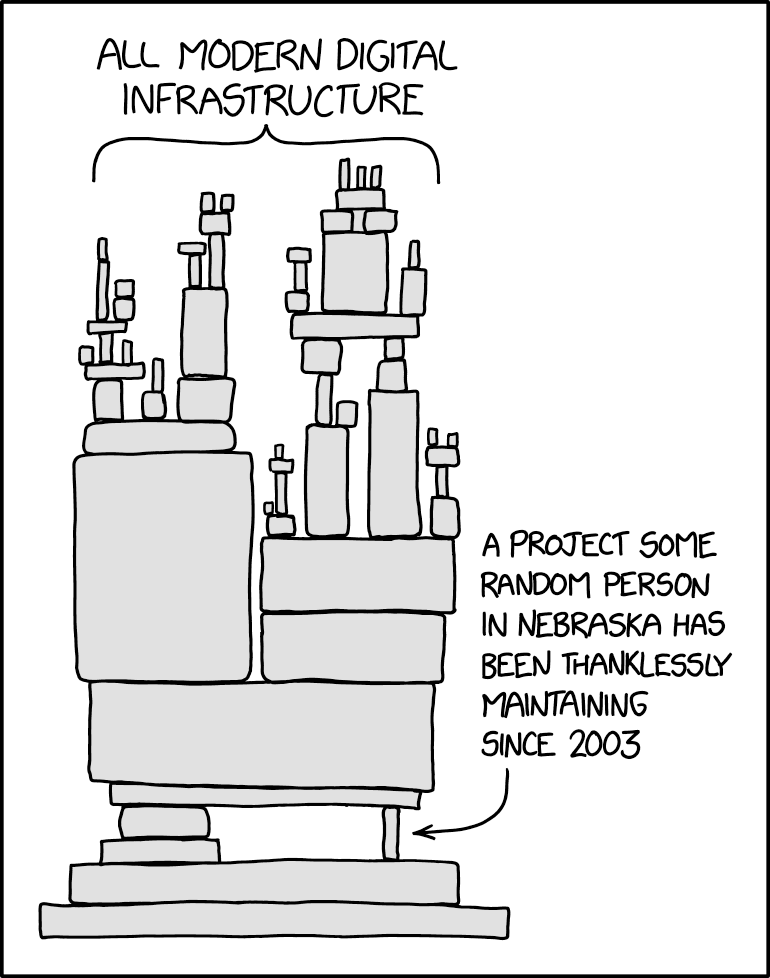
Even in theoretically “young” (flagrantly false in this case, but bear with me) projects like NixOS, you can end up with open PRs (not to mention issues!) numbering in the low tens of thousands. These same projects will also then frequently complain about the lack of available manpower.
There are things that I wouldn’t trust to an AI right now. I don’t think, for example, that large architectural rewrites or feature additions for projects that are meant to be building blocks for other projects are best left to the vibes.
For mechanical work–things like bumping versions, fixing failing tests, checking documentation for inconsistencies–the clankers have proven their worth (even before LLMs, anybody remember dependabot?)! A large part of the technical debt (and debt in developer ergonomics) for these projects is something that could be remediated using these models.
In projects like NixOS’ nixpkgs, we already make heavy use of automation (r-ryantm and friends) and mechanical verification and CI. Those deterministic systems make improving tests and suggesting minor PR refactors and things even safer. It makes it even easier to trust the contributions of clankers.
We should all be making hay while the sun shines.
Another community I’ve long been a member of–the Elixir community–has been somewhat at the forefront here.
If you look at work done by Jose Valim (in marked contrast to, say, Andrew Kelley and how he’s handling Zig) and other folks in the Elixir community (Chris McCord, Isaac Yonemoto, Zach Daniels, myself, others), there’s a clear embrace of these tools.
It isn’t done uncritically–Valim himself commented on this during a conference–but that it is being done at all has yielded and will yield dividends far beyond what we could’ve imagined even five years ago.
Valim himself commented on this during a conference
How to make hay
Random drive-by PRs from clawbots are a real concern for some maintainers (who we should try to help) and are convenient cover for the larpers (who are bozos and should be ignored). “We can barely keep on top of the PRs as it is!” “We don’t want to argue with a bot!” “Issue trackers are for humans only!”, etc. I won’t deny that can be frustrating.
The way to fix that, of course, is automated processes and mechanical guardrails. Automatic enforcement of style, automatic testing and linting and formatting–same as ever. If your community review process can’t stand up to a clanker, it wasn’t going to stand up to a flood of quarrelsome first-time contributors that really wanted their PRs merged.
We can use the whale fall tokens to build that machinery. Doing so makes it easier to manage the clanker collaboration down the road–and there’s no future where some degree of clanking does not occur, outside of projects that have decided to follow in the footsteps of the Amish (and even the Amish will selectively, slowly, adopt some good bits of what the English do!).
Whale bones last for decades and even after the fall has been picked clean they function as valuable infrastructure for the opportunists’ descendants. We need to use the whale fall to build the tools to make our futures easier, and that can be done even without trying to solve for external clanker contributors.
Want to discuss this post? |
Discuss via email |
Hacker News |
Lobsters |