

Topics
Latest
AI
Amazon
Apps
Biotech & Health
Climate
Cloud Computing
Commerce
Crypto
Enterprise
EVs
Fintech
Fundraising
Gadgets
Gaming
Government & Policy
Hardware
Layoffs
Media & Entertainment
Meta
Microsoft
Privacy
Robotics
Security
Social
Space
Startups
TikTok
Transportation
Venture
More from TechCrunch
Staff
Events
Startup Battlefield
StrictlyVC
Newsletters
Podcasts
Videos
Partner Content
TechCrunch Brand Studio
Crunchboard
Contact Us
SpaceXAI releases Grok 4.5, which Elon describes as an ‘Opus-class model’
SpaceXAI has released its latest model, Grok 4.5 — the first since the company went public several weeks ago.
In a blog post published Wednesday, SpaceXAI characterized its new release as a workhorse that can tackle all of the typical tasks that the AI industry has sought to automate: coding and app-building, office and clerical work, research, writing, and other forms of routine knowledge work.
Grok can supposedly do all this for less spend, too, as SpaceXAI says that its model has “twice greater token efficiency” than other leading models. If it carries through to real-world use cases, that efficiency would be a big advantage for SpaceXAI, since the cost of tokens has been a growing concern for AI consumers.
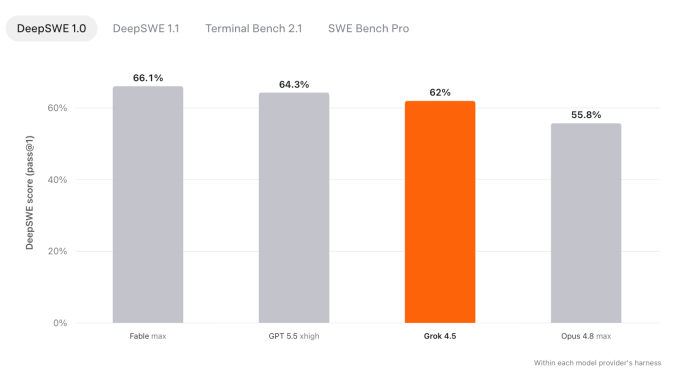
The company released benchmark metrics Wednesday that appeared to show Grok’s competitiveness with other top models from SpaceXAI competitors, although just short of best-in-class:
In a post on his social media platform X (which is a subsidiary of SpaceXAI), founder Elon Musk compared the model to Opus, Anthropic’s LLM designed for intensive and complex tasks.
“Based on strong positive feedback from customers in our beta test program, @SpaceXAI will make Grok 4.5 available to the public tomorrow. It is an Opus-class model, but faster, more token-efficient and lower cost,” wrote Musk in his post on X.
Musk later added: “Our internal assessment is that Grok 4.5 is roughly comparable to Opus 4.7, but much faster. The combination of capability, faster speed and lower cost is what makes it competitive.”
SpaceXAI says that its new model costs $2 per million input tokens and $6 per million output tokens. That’s quite competitive, if Grok’s capabilities match SpaceXAI’s rhetoric.
Opus 4.7, by comparison, costs $5 per million input tokens and $25 per million output tokens. OpenAI has tiered costs for different model versions: Sol, its most expensive, costs $5 for 1 million input tokens and $30 for 1 million output tokens, while its least expensive, Luna, costs $1 for 1 million input and $6 for 1 million output tokens.
It’s a big week for AI model releases. OpenAI is planning to release GPT 5.6, its latest, most powerful model, on Thursday. The release of that model had previously been limited by the Trump administration, due to concerns about its security implications. OpenAI has called it its “strongest model yet.”
Topics
When you purchase through links in our articles, we may earn a small commission. This doesn’t affect our editorial independence.
we may earn a small commission

Senior Writer, TechCrunch

Last chance to save up to $190 on TechCrunch Founder Summit. Join 1,000+ founders and VCs at all stages for real-world scaling insights and connections that move the needle.Savings end June 26, 11:59 p.m. PT.
Most Popular
Why raising your first found is harder than ever
Maggie Nye
Isabelle Johannessen
Why raising your first found is harder than ever
Why raising your first found is harder than ever
Why raising your first found is harder than ever
Maggie Nye
Isabelle Johannessen
Block reaches $45M settlement with 46 states over Cash App fraud probe
Aisha Malik
Block reaches $45M settlement with 46 states over Cash App fraud probe
Block reaches $45M settlement with 46 states over Cash App fraud probe
Block reaches $45M settlement with 46 states over Cash App fraud probe
Aisha Malik
The new rules of early-stage fundraising with Charles Hudson
Maggie Nye
Isabelle Johannessen
The new rules of early-stage fundraising with Charles Hudson
The new rules of early-stage fundraising with Charles Hudson
The new rules of early-stage fundraising with Charles Hudson
Maggie Nye
Isabelle Johannessen
Anthropic’s new Claude feature is quietly selling you on AI
Sarah Perez
Anthropic’s new Claude feature is quietly selling you on AI
Anthropic’s new Claude feature is quietly selling you on AI
Anthropic’s new Claude feature is quietly selling you on AI
Sarah Perez
Anthropic, OpenAI, and SpaceX are bigger than the last 25 years of tech exits
Russell Brandom
Anthropic, OpenAI, and SpaceX are bigger than the last 25 years of tech exits
Anthropic, OpenAI, and SpaceX are bigger than the last 25 years of tech exits
Anthropic, OpenAI, and SpaceX are bigger than the last 25 years of tech exits
Russell Brandom
Popular open source AI developer tool Ollama raises $65M, grows to nearly 9M users
Julie Bort
Popular open source AI developer tool Ollama raises $65M, grows to nearly 9M users
Popular open source AI developer tool Ollama raises $65M, grows to nearly 9M users
Popular open source AI developer tool Ollama raises $65M, grows to nearly 9M users
Julie Bort
Character.AI enters the microdrama arena with its own productions, but there’s a twist
Ivan Mehta
Character.AI enters the microdrama arena with its own productions, but there’s a twist
Character.AI enters the microdrama arena with its own productions, but there’s a twist
Character.AI enters the microdrama arena with its own productions, but there’s a twist
Ivan Mehta