

Topics
Latest
AI
Amazon
Apps
Biotech & Health
Climate
Cloud Computing
Commerce
Crypto
Enterprise
EVs
Fintech
Fundraising
Gadgets
Gaming
Government & Policy
Hardware
Layoffs
Media & Entertainment
Meta
Microsoft
Privacy
Robotics
Security
Social
Space
Startups
TikTok
Transportation
Venture
More from TechCrunch
Staff
Events
Startup Battlefield
StrictlyVC
Newsletters
Podcasts
Videos
Partner Content
TechCrunch Brand Studio
Crunchboard
Contact Us

Meta wants its AI glasses to seem less creepy. Its AI strategy says otherwise.
Meta’s AI glasses have a growing reputation as a creepy technology. The company hopes to change that opinion by announcing an update that will disable the camera if the LED light that indicates the glasses are recording has been tampered with.
The move is seemingly a concession to consumer sentiment that the glasses aren’t just fun, fashionable accessories, happily promoted by Kylie Jenner, but have serious implications for consumer privacy: They can be abused as surveillance devices.
Yet, even as Meta touts the new safeguard this week, the company is also pushing products and features that ask users to surrender more of their privacy to the company.
Whether that’s training its AI on your images, enabling AI features using your personal content unless you opt out, or exploring ways to continuously record or use biometric facial recognition, Meta’s vision of the future seems to always depend on collecting more of your personal data.
training its AI on your images
enabling AI features using your personal content
In its blog post about the new camera safety feature, the company pats itself on the back, noting that “no other kind of camera has done this and we’re proud to lead the industry effort.” However, Meta also admits that the move was necessary because some people had been using tape to cover the LED light, which had already forced Meta to adapt its tech to disable recording when the LED is blocked.
Determined, those same AI glasses creeps would then use “sophisticated efforts to modify or destroy the capture LED,” Meta’s announcement explains.
In other words, Meta is confirming that some people who use AI glasses have hidden agendas — namely a desire to record situations or people (often women) without their consent.
Despite this, the company is reportedly testing a prototype of AI glasses that would “continuously collect audio while taking photos every few seconds,” sources recently told Financial Times.
Meta’s blog post about the glasses feature attempts to assuage people’s fears about the devices’ privacy by answering questions like “who can see the photos and videos I take on my glasses?” Meta answers by promising, “You, and only you — unless you choose to share them.” Yet, Meta’s privacy policy has explained that any image you share with Meta AI can be used to train its AI.
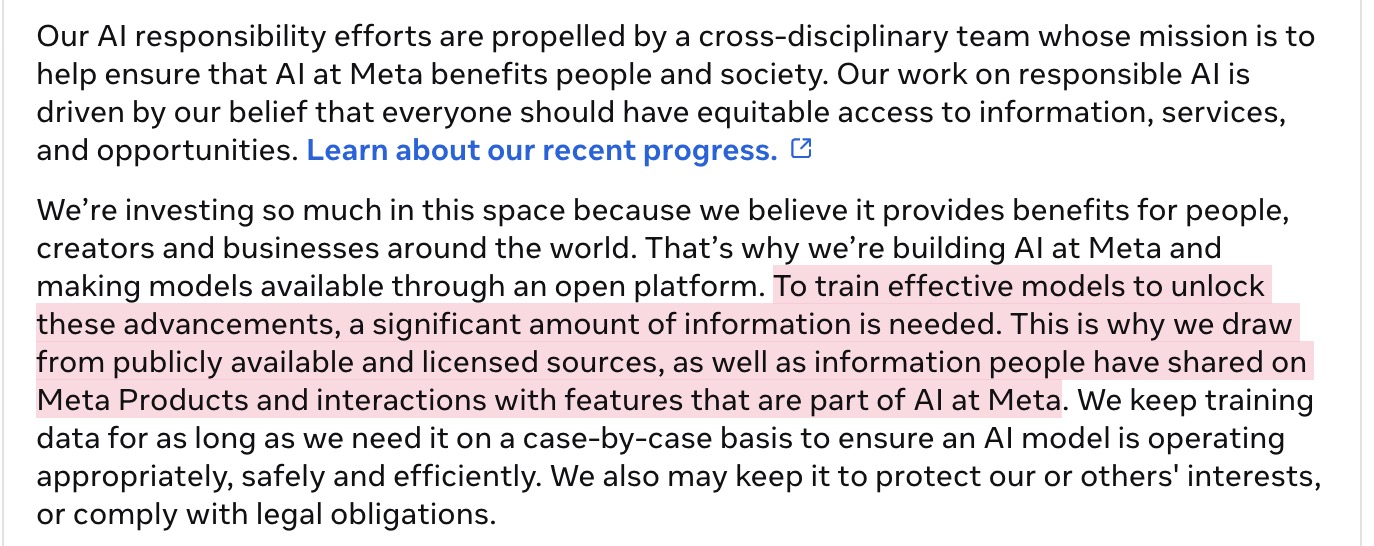
All the while, the company is facing multiple investigations and lawsuits over Meta AI glasses privacy violations. One lawsuit comes after Meta notably canceled a contract with an outsourced tech firm after some of its Kenyan workers alleged they had to view graphic content, like sex, nudity, and people using the toilet, while training Meta’s AI using people’s Meta AI glasses’ videos.
sex, nudity, and people using the toilet
These are hardly Meta’s first scrapes with privacy violations or safety measures, either.
Arguably, Meta’s reputation on privacy has been tainted for years after numerous leaks and lost lawsuits about its alleged lack of child safety measures and desire for growth at all costs. There are books by whistleblowers documenting its alleged abuses, not to mention previous large-scale privacy disasters, like the Cambridge Analytica data scandal and others.
its alleged lack of child safety measures
desire for growth at all costs
the Cambridge Analytica data scandal
After the 2018 Cambridge Analytica scandal, Meta now insists on its Privacy Progress Update page, “Since 2019, we’ve invested significantly in people, products, and technology to continue to evolve our rigorous privacy program.”
Still, the company plows forward with what many people would consider privacy-violating ideas. Case in point: On the same day it announced the Meta glasses’ new safeguard, it shared that Meta AI can now use anyone’s public Instagram photos to make AI images, unless you opt out.
Meta AI can now use anyone’s public Instagram photos
It also built features to use Meta AI on images in your Camera Roll you’ve never shared and implemented such poor privacy controls in its Meta AI app, leading users to essentially dox themselves by revealing their embarrassing searches.
use Meta AI on images in your Camera Roll you’ve never shared
revealing their embarrassing searches
This is the same company that Apple wouldn’t partner with due to privacy concerns, that records its employees’ keystrokes to train its AI, and that plans to sell targeted ads based on data in your AI chats.
Apple wouldn’t partner with due to privacy concerns
records its employees’ keystrokes to train its AI
plans to sell targeted ads based on data in your AI chats.
So, while an LED safeguard on AI glasses might be a necessary feature, consumers clearly still have many reasons to remain distrustful of how social media will use their images and data, especially in its broader AI plans.
Topics
When you purchase through links in our articles, we may earn a small commission. This doesn’t affect our editorial independence.
we may earn a small commission

Consumer News Editor

Last chance to save up to $190 on TechCrunch Founder Summit. Join 1,000+ founders and VCs at all stages for real-world scaling insights and connections that move the needle.Savings end June 26, 11:59 p.m. PT.
Most Popular
If you use Google, you’re training its AI. Here’s how to opt out.
Sarah Perez
If you use Google, you’re training its AI. Here’s how to opt out.
If you use Google, you’re training its AI. Here’s how to opt out.
If you use Google, you’re training its AI. Here’s how to opt out.
Sarah Perez
Reddit is using LLMs to solve a problem LLMs largely created
Amanda Silberling
Reddit is using LLMs to solve a problem LLMs largely created
Reddit is using LLMs to solve a problem LLMs largely created
Reddit is using LLMs to solve a problem LLMs largely created
Amanda Silberling
Amazon will stop accepting new customers for Mechanical Turk
Anthony Ha
Amazon will stop accepting new customers for Mechanical Turk
Amazon will stop accepting new customers for Mechanical Turk
Amazon will stop accepting new customers for Mechanical Turk
Anthony Ha
5 desk gadgets that can make your workday better
Aisha Malik
5 desk gadgets that can make your workday better
5 desk gadgets that can make your workday better
5 desk gadgets that can make your workday better
Aisha Malik
New Google commercial imagines a Declaration of Independence written with help from AI
Anthony Ha
New Google commercial imagines a Declaration of Independence written with help from AI
New Google commercial imagines a Declaration of Independence written with help from AI
New Google commercial imagines a Declaration of Independence written with help from AI
Anthony Ha
Chevy built an all-American EV truck — why is nobody buying it?
Tim De Chant
Chevy built an all-American EV truck — why is nobody buying it?
Chevy built an all-American EV truck — why is nobody buying it?
Chevy built an all-American EV truck — why is nobody buying it?
Tim De Chant
Mark Zuckerberg tells staff that AI agents haven’t progressed as quickly as he’d hoped
Lucas Ropek
Mark Zuckerberg tells staff that AI agents haven’t progressed as quickly as he’d hoped
Mark Zuckerberg tells staff that AI agents haven’t progressed as quickly as he’d hoped
Mark Zuckerberg tells staff that AI agents haven’t progressed as quickly as he’d hoped
Lucas Ropek