

Topics
Latest
AI
Amazon
Apps
Biotech & Health
Climate
Cloud Computing
Commerce
Crypto
Enterprise
EVs
Fintech
Fundraising
Gadgets
Gaming
Government & Policy
Hardware
Layoffs
Media & Entertainment
Meta
Microsoft
Privacy
Robotics
Security
Social
Space
Startups
TikTok
Transportation
Venture
More from TechCrunch
Staff
Events
Startup Battlefield
StrictlyVC
Newsletters
Podcasts
Videos
Partner Content
TechCrunch Brand Studio
Crunchboard
Contact Us
Posted:

Russell Brandom
Google’s deepfake detector system used to debunk McConnell hoax pic
Google’s SynthID system has been used to debunk a high-profile AI-generated hoax image, in a rare but significant win for the system.
Earlier this week, a picture circulated online that seemed to show Kentucky Senator Mitch McConnell covered in tubes in a hospital bed in a state of extreme distress. The image was shared widely on Reddit and X, but by Wednesday, the revered fact-checking site Snopes had debunked the image, noting that, when checked, the image registers as containing the SynthID watermark designed by Google to identify AI-generated pictures.
In short, the watermark worked exactly as it was supposed to in a win for anti-deepfake technology.
Senator McConnell’s health has been the subject of intense speculation since he checked into the hospital after an emergency call on June 14. Since that time, he’s been largely absent from the public eye, fueling speculation that his health may be failing. In this case, however, the evidence proved to be entirely fake.
after an emergency call on June 14
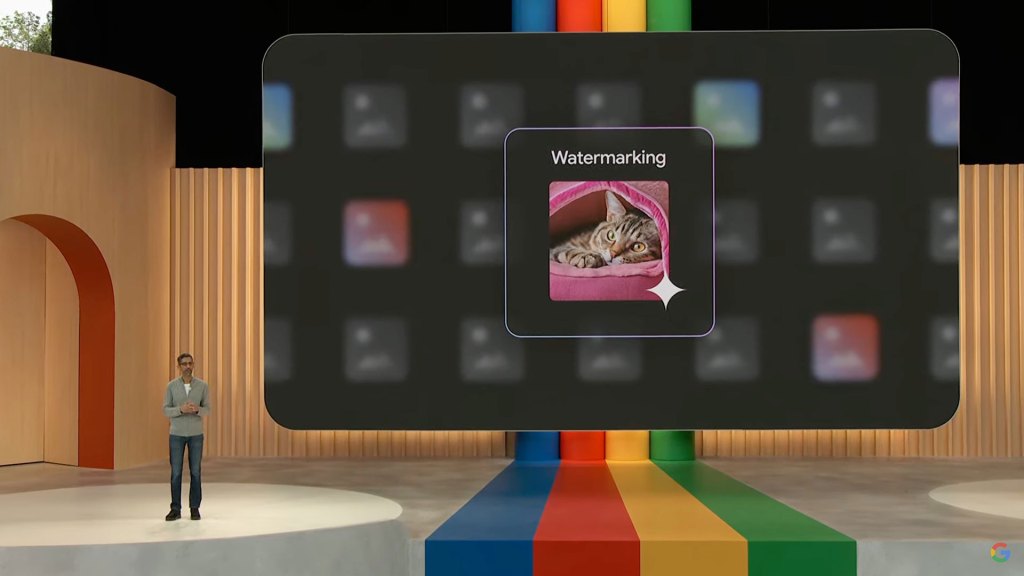
Launched at Google’s I/O developer conference in 2025, SynthID works as an invisible signature, visible to SynthID algorithms but designed to be unnoticeable to the casual observer. Because the signature is built into the image itself, it survives even when an image is screencaptured across multiple platforms, as the McConnell image was.
SynthID’s main limitation is that it can only be used when an image-generation tool actively participates in the program. Gemini models have included the watermark since the program launched in 2025. OpenAI joined in May 2026, as part of a broader effort to fight malicious image generation. Anthropic does not participate in the program.
a broader effort to fight malicious image generation
Users can check if images contain the watermark by asking a Gemini model or uploading them to OpenAI’s public image verification tool.
OpenAI’s public image verification tool
Topics

Last chance to save up to $190 on TechCrunch Founder Summit. Join 1,000+ founders and VCs at all stages for real-world scaling insights and connections that move the needle.Savings end June 26, 11:59 p.m. PT.
Newsletters
Subscribe for the industry’s biggest tech news
Every weekday and Sunday, you can get the best of TechCrunch’s coverage.
TechCrunch Mobility is your destination for transportation news and insight.
Startups are the core of TechCrunch, so get our best coverage delivered weekly.
Provides movers and shakers with the info they need to start their day.
By submitting your email, you agree to our Terms and Privacy Notice.
Related
AI
Anthropic, OpenAI, and SpaceX are bigger than the last 25 years of tech exits
Russell Brandom
2 hours ago

Anthropic, OpenAI, and SpaceX are bigger than the last 25 years of tech exits
Anthropic, OpenAI, and SpaceX are bigger than the last 25 years of tech exits
Russell Brandom
AI
SpaceXAI releases Grok 4.5, which Elon describes as an ‘Opus-class model’
Lucas Ropek
21 hours ago

SpaceXAI releases Grok 4.5, which Elon describes as an ‘Opus-class model’
SpaceXAI releases Grok 4.5, which Elon describes as an ‘Opus-class model’
Lucas Ropek
AI
Why the rise of open source AI isn’t hurting Anthropic … yet
Russell Brandom
2 days ago

Why the rise of open source AI isn’t hurting Anthropic … yet
Why the rise of open source AI isn’t hurting Anthropic … yet
Russell Brandom
Latest in AI
AI
Anthropic’s new Claude feature is quietly selling you on AI
Sarah Perez
1 hour ago

Anthropic’s new Claude feature is quietly selling you on AI
Anthropic’s new Claude feature is quietly selling you on AI
Sarah Perez
AI
Anthropic, OpenAI, and SpaceX are bigger than the last 25 years of tech exits
Russell Brandom
2 hours ago
Anthropic, OpenAI, and SpaceX are bigger than the last 25 years of tech exits
Anthropic, OpenAI, and SpaceX are bigger than the last 25 years of tech exits
Russell Brandom
Startups
Popular open source AI developer tool Ollama raises $65M, grows to nearly 9M users
Julie Bort
3 hours ago

Popular open source AI developer tool Ollama raises $65M, grows to nearly 9M users
Popular open source AI developer tool Ollama raises $65M, grows to nearly 9M users
Julie Bort