Gigatoken
~1000x faster than HuggingFace's tokenizers, drop-in replacement.
Tokenize your text data at GB/s!
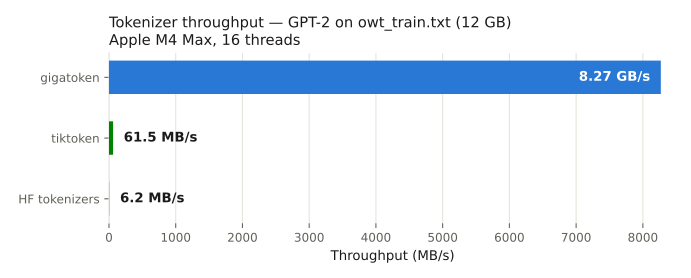
Note that both HF tokenizers and tiktoken are already running multithreaded Rust!
What is Gigatoken?
Gigatoken is the fastest tokenizer for language modeling.
It supports a wide range of CPU hardware, and nearly all commonly used tokenizers.
See the Benchmarks section for detailed throughput numbers across tokenizers and CPUs.
Installation
Usage
Gigatoken can be used with its own API, or in compatibility mode with HuggingFace Tokenizers or Tiktoken.
Compatibility Mode (Easiest)
A substantial amount of effort has been put into making sure the outputs match exactly with what you would get with HuggingFace Tokenizers in this setting, but this is at a non-negligible cost to performance.
You can still expect way faster performance across the board, but not quite the 1000x you will get with the Gigatoken API.
Gigatoken API (Fastest)
Using the Gigatoken API lets the Rust implementation read data directly, and skips as much overhead as possible while allowing for maximum parallelism.
Keep in mind that passing Python data structures through this API still incurs the overhead of reading from Python.
Benchmarks
OWT (openwebtext) was chosen because it's roughly representative of the text you get after extraction from CommonCrawl documents.
Gigatoken encodes the whole file un-split, and is thus doing more work than the other tokenizers to find the split boundaries and automatically parallelize.
HuggingFace tokenizers (encode_batch_fast) gets the first 100 MB and tiktoken (encode_ordinary_batch) the first 1 GB, both presplit on <|endoftext|>.
This is fair because neither of the compared tokenizers do caching, meaning the speed is roughly uniform throughout processing.
Tiktoken rows are currently only filled in for tokenizers with official support.
The slowest rows are the SentencePiece-based tokenizers, which are not well optimized in Gigatoken.
Each row is one distinct tokenizer (identical vocab/merges/pretokenizer), measured on a representative repo.
If you don't see your tokenizer here, it's likely based on some existing one.
For instance:
Llama 3 / 3.1 / 3.2 — Llama 3 / 3.1 / 3.2, DeepSeek-R1-Distill-Llama, Hermes 3, Saiga, and other Llama-3 finetunes
Llama 3.3 — Llama 3.3, Llama-3.1-Nemotron-Nano-VL, SmolLM3, Kanana 1.5, jina-embeddings-v5, Ultravox
Qwen 2 / 2.5 — Qwen 2 and 2.5 (incl. Coder and VL), Qwen3-Coder, Qwen3-VL, DeepSeek-R1 Qwen distills, MiMo V2.5, MiniCPM-o 2.6, InternVL3
Qwen 3 — Qwen 3 (incl. Embedding and Reranker), Qwen2.5-Omni, Qwen3-VL-Embedding, MiMo V2.5 Pro, jina-reranker-m0, pplx-embed, MOSS-TTS, Zeta
DeepSeek V3 / R1 / V4 — DeepSeek V3 / V3.1 / V3.2, R1, V4 Flash and Pro, DeepSeek-VL2
GLM 4 — GLM 4.1V, 4.5, and 4.7
GLM 5 — GLM 5 / 5.2 and GLM-4.7-Flash
Nemotron 3 — Nemotron 3 Nano, Super, and Ultra
Kimi K2 — Kimi K2 / K2.5 / K2.6 / K2.7, Kimi-Linear, Kimi-VL, Moonlight
Phi-4-mini — Phi-4-mini and Phi-4-multimodal
TinyLlama / Phi-3 (Llama 2) — TinyLlama, Phi-3-mini, Phi-3.5-mini and Phi-3.5-vision (the Llama 2 vocab)
Gemma 3 — Gemma 3 (270M–27B) and EmbeddingGemma
Gemma 4 — Gemma 4 (dense, MoE, and E-series) and DiffusionGemma
FAQ
Q: Did you just way over-optimize for a specific CPU and tokenizer? How is it so fast?
No, I way over-optimized for every combination of these!
The results are very consistent across CPUs (modern x86 and ARM), and across specific tokenizers.
The major improvements are in optimizing heavily an implementation that usually is outsourced to a Regex engine (pretokenization) using SIMD, minimizing branching and other tricks, as well as heavily optimizing caching of pretoken mappings (if a word has been seen before, look it up its encoded tokens efficiently).
Caching is a very hard problem in this domain since the cache grows very quickly, and pretoken distributions are very long-tailed.
Some gains are also achieved from minimizing interactions with Python, and avoiding communication between threads.
Q: How can I quickly check if my tokenizer is supported?
You can try it out without installing anything! The following command will validate and time tokenization for a given HuggingFace model repo:
At the rates we see on the EPYC CPU, you could tokenize the entirety of Common Crawl (often considered to be the entire internet, 130 trillion tokens) in just under 6.5 hours!
This example uses the train sample from this dataset, and the CLI by default subsets to the first 100MB of the file for validation and comparison with HF.
You can see help for these flags with uvx gigatoken bench --help.
You might need to run your commands twice on macOS to get a good reading, since the first run will always perform a security scan, which will slow down the Rust code.
Q: I've found a mismatch/slow use-case, is this expected?
Most likely not! Despite reasonably wide testing I don't have every use-case on hand, so please report anything you find in a GitHub Issue so I can address it as soon as possible.
Citation
If you use Gigatoken in your research, please cite it as:
Known Issues
Python iteration is handled in Rust, but uses ABI3, which is slower than using internal version-specific CPython APIs. In the future I intend to specialize for each Python version to cut this overhead. Early experiments show a 2x speed improvement for overhead-bound cases.
File sinks are not yet implemented in the Gigatoken API.
WordPiece is not yet supported.
SentencePiece-based tokenization is not nearly as optimized as the more common BPE tokenizers. This is low priority for now since mostly Google models/BERT style models use SentencePiece.
Windows has not been tested much, so for now prefer using WSL.
Implementing the user-facing API
Widening of compatibility, for instance generalizing and porting the pretokenizer implementations to support more tokenizers, less interesting features like padding/truncation/unicode normalization
Porting SIMD strategies between AVX512/AVX2/NEON
Final profiling stages and the last ~4x worth of performance from eliminating branching and improving the pretoken cache hierarchy
Refactoring and code reuse